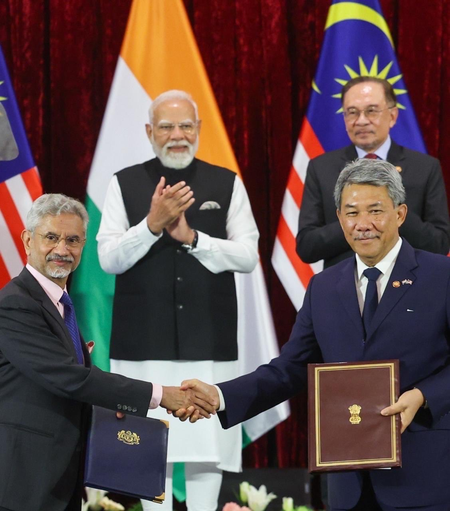
Kuala Lumpur, February 8: Indian Prime Minister Narendra Modi and Malaysian Prime Minister Anwar Ibrahim signed six significant agreements during their bilateral meetings in Kuala Lumpur on Sunday. The agreements aim to enhance cultural, economic, and strategic cooperation between the two nations.
This signing followed extensive discussions between the two leaders during PM Modi’s two-day official visit to Malaysia. According to the Ministry of External Affairs, this visit marks a crucial step in advancing the comprehensive strategic partnership between India and Malaysia.
During their talks, both leaders explored avenues to strengthen collaboration in various sectors, including trade, investment, semiconductors, defense, security, maritime cooperation, energy, renewable resources, tourism, cultural exchange, as well as digital and new technologies.
They expressed a mutual intention to enhance cooperation in both traditional and modern sectors for mutual benefit. Several important bilateral agreements and MOUs were exchanged during this visit, covering areas such as security cooperation, participation in UN peace initiatives, semiconductor development, healthcare and medicine, disaster management, anti-corruption efforts, audio-visual co-production, vocational education, and social security for Indian workers in Malaysia.
Additionally, Prime Minister Modi announced the establishment of a special Thiruvalluvar Center at the University of Malaya and the initiation of the Thiruvalluvar Scholarship. The Ministry of External Affairs stated that this initiative aims to promote the teachings and philosophy of the ancient Tamil poet and philosopher Thiruvalluvar, while also strengthening cultural exchanges and relationships between the people of India and Malaysia.
Modi also revealed India’s decision to open its first consulate in Malaysia. This move is expected to enhance diplomatic engagement, strengthen bilateral relations, and provide better support for Indian citizens residing in or visiting Malaysia.
Among the agreements signed, collaboration between Cyberjaya University and ITRA Jamnagar was highlighted as a significant development. According to the MEA, this partnership will focus on traditional medicine, facilitating research and academic exchanges in Ayurveda, and enhancing access to holistic healthcare practices and knowledge sharing between the two countries.
In efforts to improve connectivity and economic integration, the National Payments Corporation of India’s subsidiary, NIPL, and Malaysia’s PenNet agreed to work together on establishing bilateral payment linkages, including integration through the Unified Payments Interface (UPI).
This initiative is expected to ease business operations and provide affordable remittance and payment solutions for the tourism, student, and business communities working between the two countries.
Furthermore, both leaders received the report from the 10th India-Malaysia CEO Forum during this visit. The forum’s report is anticipated to offer suggestions and insights to strengthen business-to-business cooperation and enhance trade and investment opportunities between India and Malaysia, deepening economic ties.