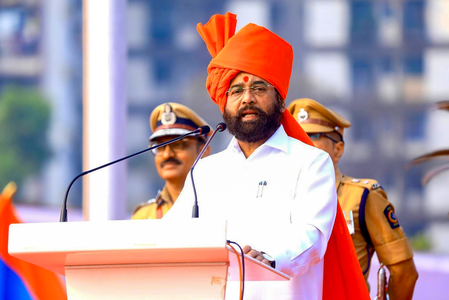
New Delhi, February 8: A poor boy, whose financial struggles prevented him from pursuing education, found himself driving an auto rickshaw to support his family. One day, he became the Chief Minister of Maharashtra, a moment that surpassed even the joy of major festivals for his family. While his journey into politics began amidst the complexities of Maharashtra’s political landscape, it was the relentless efforts of a dedicated Shiv Sena member that paved the way for his success. This is the inspiring story of Eknath Shinde, the former Chief Minister and current Deputy Chief Minister of Maharashtra.
Born on February 9, 1964, in Satara district, Eknath Shinde hailed from a humble background, making education a significant challenge. Faced with poverty, he had to work as an auto driver to make ends meet.
Shinde reflects, “During my time as an auto rickshaw driver, I learned that whatever work comes my way, it should be done with honesty.”
His interest in politics gradually grew. In the 1980s, at the age of 18, he entered the political arena dominated by Anand Dighe in Satara, who was a prominent figure for Shiv Sena in Thane. Shinde joined Shiv Sena, marking the beginning of his political journey, with Dighe becoming his political mentor. He aimed to establish his identity within the party and never missed an opportunity to stand alongside party leaders at demonstrations.
In an interview, Shinde stated, “I began my political career through social work. Whether it was Balasaheb Thackeray or my mentor Anand Dighe, they entrusted me with responsibilities that I fulfilled diligently. I worked hard to achieve what we needed.”
His political journey began with grassroots efforts, such as digging pits and setting up pavilions during the Ganesh festival. His dedication to serving the community opened more doors for him in politics. Participation in protests helped him gain recognition among party leaders.
In 1997, Shinde received the opportunity he had been seeking. This marked a new chapter in his political life when Shiv Sena nominated him as a candidate for the Thane Municipal Corporation. He won the election by a significant margin, and in 2001, he was appointed as the opposition leader in the municipal corporation.
Shinde maintained a strong foothold within Shiv Sena, and his image as a staunch Shiv Sainik led to more opportunities. After a few years, in 2004, he was again given a chance, this time to contest in the assembly elections. He upheld the party’s trust by winning from Thane and advancing to the assembly. His stature within Shiv Sena grew, and he was elected as the leader of the opposition in 2014. The following year, he was appointed as a minister in the BJP-Shiv Sena coalition government.
The day finally arrived when Eknath Shinde took the oath of office as Chief Minister at Raj Bhavan. This was the culmination of a rebellion that had led to the overthrow of the Uddhav Thackeray government.
The Shiv Sena has always been closely associated with the Thackeray family, but Shinde not only stood against them but also rallied a majority of legislators to take control of the party.
This political upheaval is often seen as a power struggle between the BJP and Shiv Sena. Both parties had won the assembly elections together, but after the victory, Uddhav Thackeray insisted on retaining the Chief Minister position. He even allied with the Congress party, a long-time adversary of Shiv Sena, to assume the role of Chief Minister.
Months later, Shinde led a group of legislators to not only seize Thackeray’s position but also expel him from the real Shiv Sena.
When Shinde returned to the BJP, many expected the Chief Minister position to go to the BJP. However, Devendra Fadnavis surprised everyone by announcing that the position would be given to Eknath Shinde. Thus, Shinde became the Chief Minister of Maharashtra. After forming the government again with the BJP, he was appointed as Deputy Chief Minister.