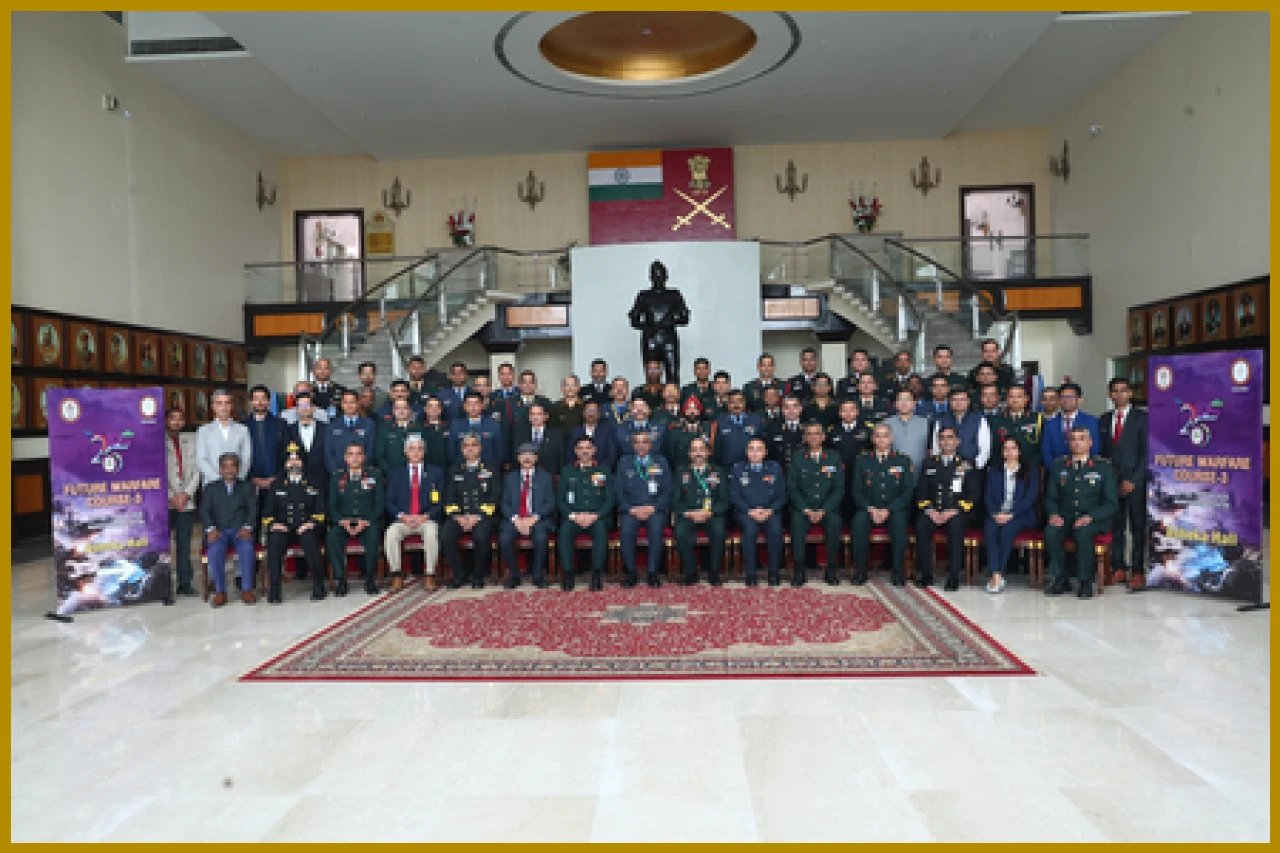
New Delhi, February 5: The third edition of the Tri-Services Future Warfare Course is currently underway at the Manekshaw Centre, running from February 2 to February 25, 2026. This year, the course emphasizes cyber and Cognitive Warfare modules, which are crucial for understanding the evolving dimensions of future conflicts.
The course aims to provide officials with a comprehensive understanding of cyber, information, and cognitive warfare, while also developing strategic thinking and adaptability.
In his address, Chief of Integrated Staff Air Marshal Ashutosh Dixit stated that future warfare will significantly involve not only traditional operations but also cyber and cognitive aspects. He highlighted that military decisions, operational planning, and strategic advantages will increasingly depend on comprehending complex information environments, countering adversarial influence campaigns, and effectively utilizing digital and cognitive tools. He also noted that India’s preparedness in these areas is vital for maintaining credible deterrence and operational superiority.
Participants in this course include a diverse group of officers from the Army, Navy, and Air Force, along with DRDO scientists, academics, and representatives from the technical and defense industries. This mix has facilitated a vibrant exchange of ideas, allowing participants to understand how cognitive and cyber capabilities can be integrated into Multi-Domain Operations.
Additionally, they explored how emerging technologies, such as AI, neural networks, and automated intelligence systems, can be leveraged for operational advantages.
The involvement of industrial and academic experts ensures that participants gain insights into the balance between technological innovation and operational needs, providing them with knowledge of real-world applications and technological trends related to national security. By combining theory, operational scenarios, and a multi-domain approach, the Future Warfare Course prepares participants to address both conventional and unconventional threats effectively.
Upcoming modules will include presentations on multi-domain operations, land, naval, and air warfare exercises, as well as operational problem statements. This comprehensive approach ensures that participants not only understand emerging threats but also develop practical strategies to maintain India’s operational capabilities.