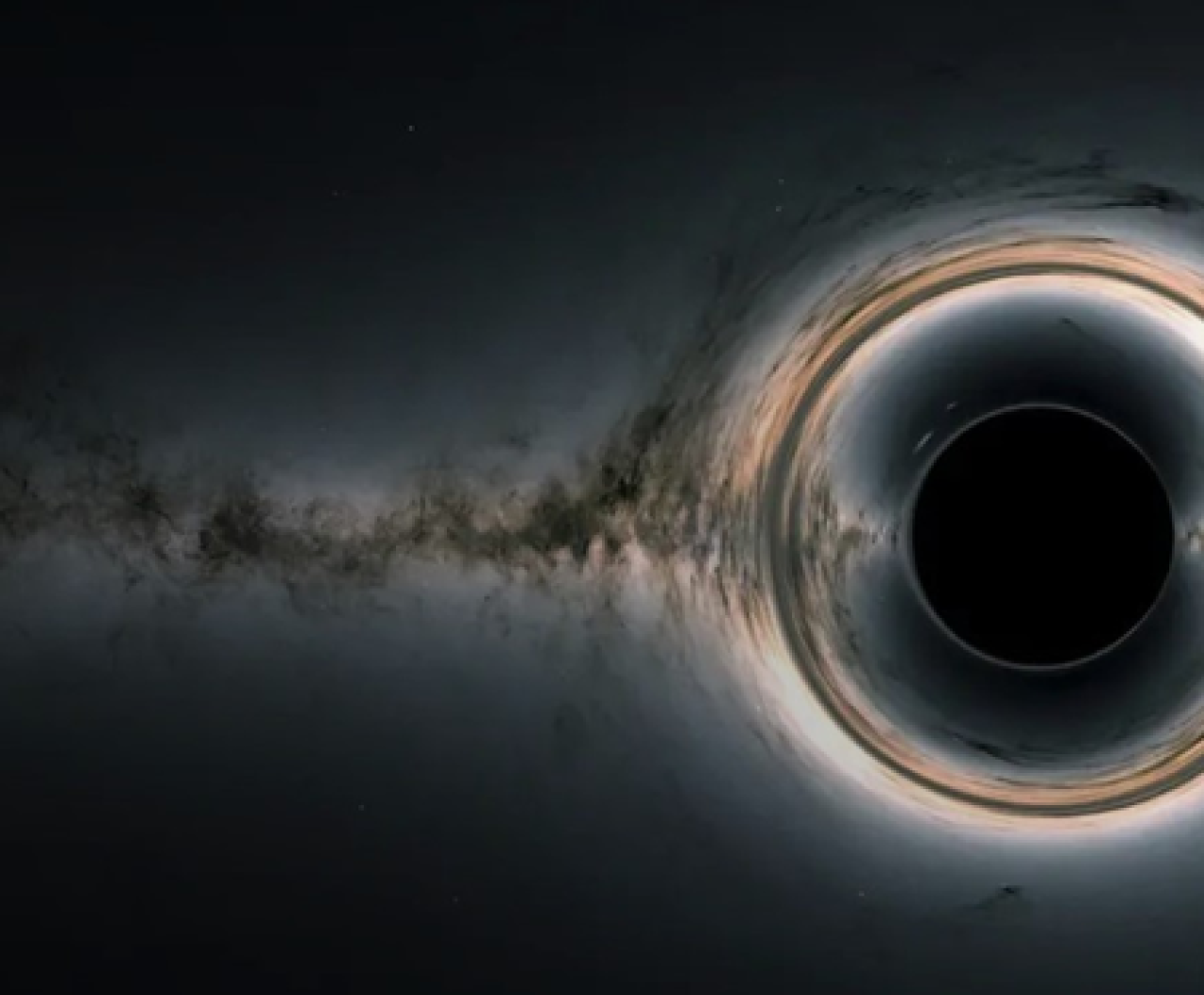
New Delhi, February 25: black holes rank among the most intriguing mysteries of space. Contrary to their name, they are not mere “holes” but regions where an immense amount of mass is compressed into a small volume, resulting in an incredibly powerful gravitational pull. This force is so strong that not even light can escape its grasp.
As a result, black holes appear black, as they do not reflect light. Surrounding a black hole is a swirling ring of gas and dust known as an accretion disk. This disk heats up to such high temperatures that it emits X-rays and other forms of light, allowing scientists to gather information about the black hole.
Black holes bend light from distant sources due to their intense gravitational force, similar to how a glass lens bends light. This effect causes objects behind a black hole to appear larger, distorted, or multiple times, a phenomenon scientists use to detect hidden black holes that are otherwise invisible. This process is referred to as gravitational lensing in scientific terms.
NASA provides insights into black holes. According to the agency, at the center of a black hole lies a point where everything is compressed to an infinite density, known as the event horizon. This invisible boundary ensures that anything crossing it cannot return, not even light. Our Milky Way galaxy also harbors a supermassive black hole named Sagittarius A*, which is 4 million times the mass of our sun.
Interestingly, if an object approaches a black hole too closely, it can be stretched and compressed into a noodle-like shape due to gravitational forces, a phenomenon called spaghettification. The largest known black hole is TON 618, which is 660 billion times heavier than the sun, while the smallest discovered black hole is just 3.8 times the mass of the sun. All black holes rotate, with some spinning so fast that they complete over a thousand rotations per second.
Black holes are neither wormholes nor vacuum cleaners that suck everything in. They form when massive stars exhaust their fuel and explode in supernovae. From a distance, their effects appear similar to those of ordinary stars. These cosmic enigmas remain some of the universe’s greatest mysteries, and scientists are continuously striving to understand them.