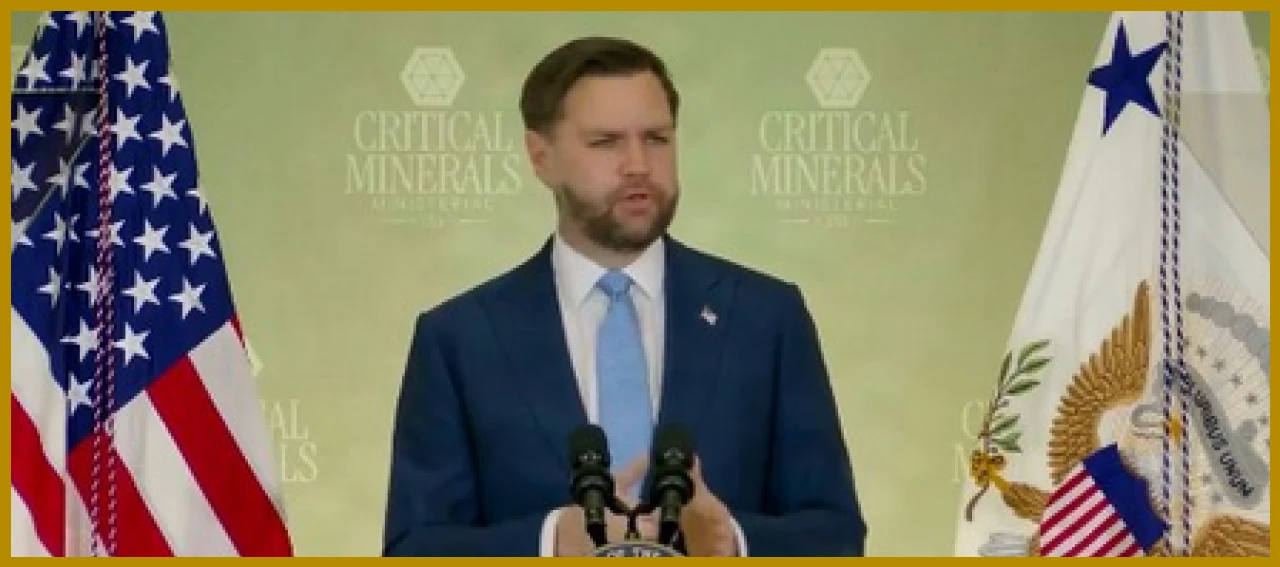
Washington, February 4: The United States has urged its allied and partner nations to join a proposed “Critical Minerals Trading Block.” The Trump administration emphasizes the need for coordinated global action to stabilize markets and secure supply chains.
During the opening of the “critical minerals Ministerial” meeting in Washington, U.S. Vice President J.D. Vance outlined this initiative. He stated that the global market for critical minerals is not functioning effectively, putting economies at risk.
Vance remarked, “Nothing is more real than critical minerals.” He identified them as essential for modern economies, national defense, and advanced technology.
He pointed out that existing supply chains are extremely vulnerable and concentrated in a few countries. There are significant price fluctuations, investment instability, and many projects collapse when sudden supply increases lead to price drops.
The Vice President noted that the countries participating in the meeting represent nearly two-thirds of the global GDP, and together they have the power to change the market’s direction. He emphasized, “We are all on the same team.”
Vance proposed the creation of a preferential trade zone for critical minerals. This zone would be protected from external disruptions and based on established reference prices at every stage of production.
He explained that these prices would act as a price floor, enforced through adjustable tariffs. The goal is to prevent cheap dumping in the market, which harms domestic producers and drives away long-term investors.
“We want allied and partner countries to come together to form a trading block,” Vance stated. According to him, stable prices will aid private investment and long-term planning, ensuring mineral availability in emergencies.
He added that the initiative aims to develop diverse production centers to strengthen supply chains and make the market more predictable.
Following Vance, U.S. Secretary of State Marco Rubio also delivered an opening speech. He stated that this issue is directly linked to National Security. Rubio noted, “Critical minerals are essential for the tools we use daily.” He explained that these minerals power infrastructure, industry, and national defense.
Rubio mentioned that President Donald Trump prioritized this issue from his first day in office. He referenced an executive order issued in March aimed at expediting mining project approvals, promoting domestic mining, and strengthening supply chains both domestically and internationally.
He highlighted that in October, the U.S. signed critical mineral agreements worth over $10 billion with five countries. Additionally, he referred to the “Pax Silica Summit” held in December, which initiated partnerships for a robust silicon supply chain.
Rubio warned that the development of technologies like artificial intelligence cannot occur without reopening mines and rebuilding factories.
He recalled that the discovery of rare minerals at Mountain Pass in California in 1949 accelerated the Jet Age, Space Age, and Computer Age. In subsequent years, mining was neglected, manufacturing moved overseas, and supply chains weakened.
Rubio stated, “One day we realized we had outsourced our economic security and future.”
He compared the current situation to the Washington Energy Conference held nearly 50 years ago, which led to the establishment of the International Energy Agency when oil began to be used as a political pressure tool.
Rubio stressed, “This is not just an American initiative. It should be an international and global effort with like-minded countries.”