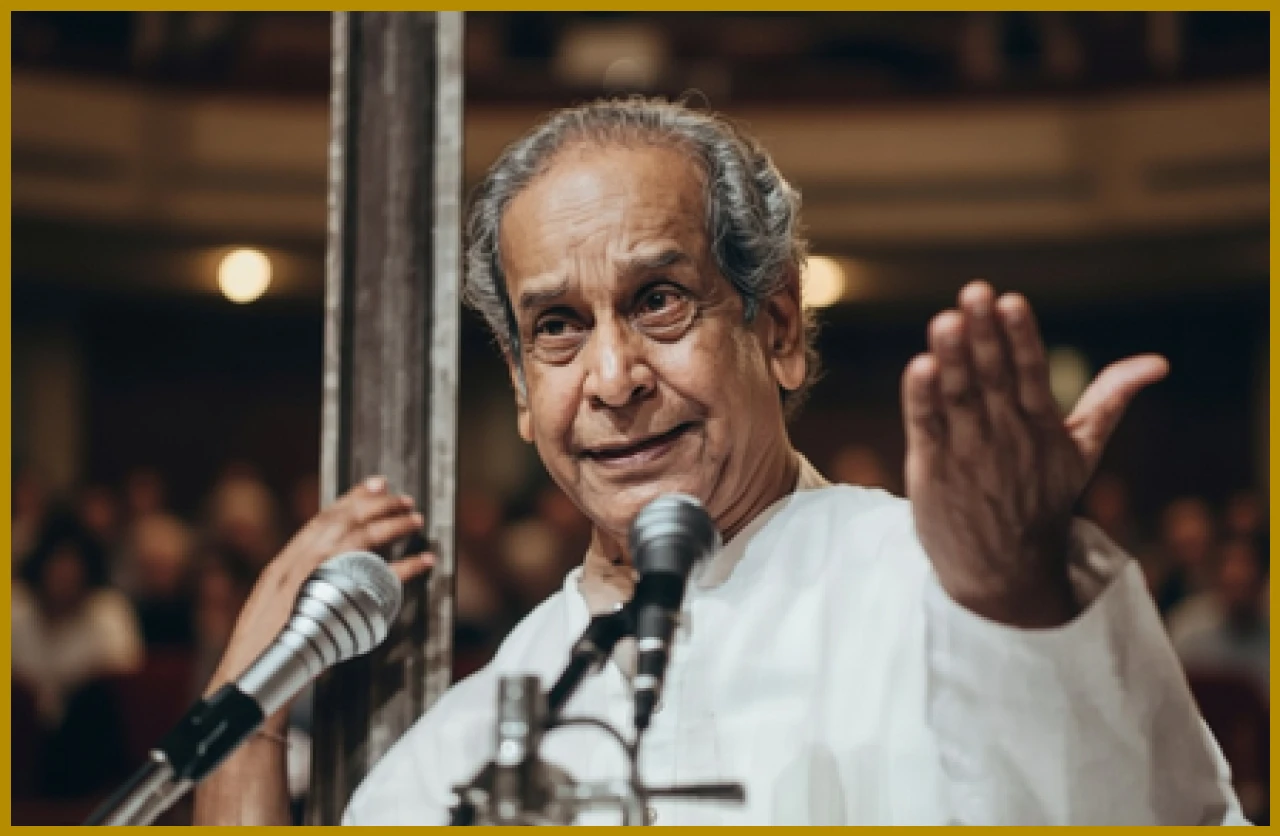
Mumbai, February 4: Great stories in history often emerge from humble beginnings. The tale of Pandit Bhimsen Joshi, a luminary in Hindustani classical music, began in a modest gramophone shop. As a child, listening to the songs played on the gramophone while returning from school ignited a passion that would eventually crown him as the king of melodies. The ragas he absorbed in that shop nurtured his confidence to become a musician.
Born on February 4, 1922, in Gadag district, Karnataka, Bhimsen was the eldest in his family, which valued education and discipline. His father, Gururaj Joshi, was a scholar of languages, yet no one in the family pursued Music. Despite this, Bhimsen was drawn to music from a young age. He often paused in front of gramophone and transistor shops on his way home from school, listening intently to the records and attempting to hum the tunes. That gramophone shop became his first ‘music class.’
Driven by his passion for music, he left home at the tender age of 11 in search of a guru. At that age, he had no knowledge of his destination or the path ahead; his only compass was an intense desire to learn music. During his journey, he wandered through various cities, singing outside temples and in the streets. It was during this quest that he met the legendary guru, Pandit Sawai Gandharva, who told Bhimsen that to learn from him, he must forget everything he had learned so far. Without hesitation, Bhimsen accepted this condition, marking the beginning of his true musical journey.
In 1941, at just 19 years old, he made his first public performance. His voice resonated with both strength and emotion. Soon after, he moved to Mumbai, where he began working as a radio artist. Through radio, his voice reached every corner of the country. At the age of 20, his first album was released, establishing his identity in the classical music realm.
Pandit Bhimsen Joshi is revered as a master of khayal singing. His command over ragas such as Darbari, Malkauns, Todi, Yaman, Bhimpalasi, Lalit, and Shuddha Kalyan was exceptional. Alongside classical music, he also sang bhajans and Vitthal. His singing embodied the simplicity and depth that once sparkled in his eyes as he stood in that gramophone shop.
For his significant contributions, he was honored with the Padma Bhushan, Padma Vibhushan, and in 2008, the highest civilian award in India, the Bharat Ratna. Pandit Bhimsen Joshi passed away on January 24, 2011, after a prolonged illness.